From Regulation to Recovery: Collaboration Takes Centre Stage at IARC 26
April 8th, 2026
Back to posts
April 8th, 2026
Back to postsA milestone event for a sector under pressure.
IARC 26 showed that tighter ELV regulation and better recovery technology are not enough on their own. Across metals, plastics, batteries and data systems, speakers agreed that greater circularity will depend on closer collaboration between OEMs, recyclers, dismantlers, policymakers and material specialists to turn regulatory ambition into workable, scalable recovery systems.

Marking its 25th anniversary, the International Automotive Recycling Congress (IARC) was held in Hamburg, Germany, from 25 to 27 March, bringing together recyclers, manufacturers, policymakers and materials specialists to examine the fast-changing demands now facing the end-of-life vehicle treatment sector.
Delegates were welcomed by Olivier François, chair of the steering committee and president of Recycling Europe and the Bureau of International Recycling, as the industry gathered against a backdrop of tighter regulation, rising circularity targets and growing pressure to secure high-quality secondary materials.
If one theme ran through almost every session, it was collaboration. Speakers differed on policy, pace and priorities, but across metals, plastics, batteries, glass and critical minerals, the message was strikingly consistent: the technical pathways to greater circularity are becoming clearer, but none of them will scale without closer coordination between vehicle makers, dismantlers, material producers, recyclers, policymakers and data managers.
That became clear from the opening keynote contributions. Murat Bayram of European Metal Recycling warned that tighter export controls, tariffs and wider geopolitical fragmentation could destabilise the economics of the recycling chain, particularly for non-ferrous metals. Recyclers, he argued, still need open markets to balance fluctuating volumes and qualities of recovered material, and restrictions risk weakening investment across the wider automotive value chain.
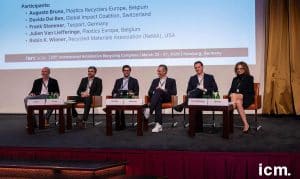
Robin Wiener of the Recycled Materials Association reinforced that concern from a US perspective, arguing that end-of-life vehicles remain a major source of recycled steel, aluminium, copper and plastics and that export access remains essential when domestic demand cannot absorb available volumes. She also pointed to Chinese-backed efforts around an ISO standard for recycled steel as a potential disruptor to existing global trade flows and specifications.
From there, the conference moved on to policy. Jaco Huisman of the European Commission outlined the likely structure of the new End-of-Life Vehicles Regulation, describing it as a broad shift towards circular vehicle design, stronger treatment obligations, digital data systems and tighter controls on exports. The framework is expected to be formally adopted in 2026 and applied from around 2028.
Silvia Vecchione of ACEA said vehicle manufacturers broadly welcome a more harmonised system, particularly where it addresses missing vehicles, illegal dismantling and uneven enforcement. But she also stressed that regulation will only work if ambitions are matched by realistic implementation, especially where recycled content targets depend on the future availability of high-quality secondary materials.
Heavy-duty vehicles added another layer to the debate. Pavel Elizarov of TRATON said that trucks and buses will be formally drawn into EU circularity rules for the first time, but warned that they should not be treated simply as larger passenger cars. The heavy-duty sector has longer service lives, more established remanufacturing traditions, and more complex vehicle configurations, meaning that future progress will depend on cooperation among producers, operators, and treatment networks.
Regina Kohlmeyer of Germany’s Environment Agency widened the lens further by framing ELV recycling as much of a climate issue as a waste issue. The real challenge, she argued, is not just collecting more vehicles but producing cleaner, more usable secondary raw materials by stripping out pollutants and improving the quality of recovered metals and plastics. That again points back to shared responsibility across the chain, not just at the dismantling stage.
That gap between ambition and delivery surfaced repeatedly, particularly in the discussion around plastics. In a panel hosted by Hyundai’s Timo Unger, delegates were shown estimates suggesting that recycled content rules could require around 672,000 tonnes a year of high-quality post-consumer automotive recyclate by 2032 and 1.12 million tonnes by 2036. The challenge, several speakers suggested, is that Europe may be setting demand targets faster than it is building the domestic feedstock, traceability and processing infrastructure needed to meet them competitively.

The closing session of day one pushed the same argument into metals. Umberto Eynard of the European Commission’s Joint Research Centre said Brussels is now studying the feasibility of recycled steel and aluminium content requirements in new vehicles. Hannah Gross and Jean-Philippe Hermine of IMT-IDDRI showed how better dismantling and post-shredder sorting could reduce copper contamination in ELV steel scrap and make more closed-loop car-to-car steel recycling possible. Erik Vegter of M2i added that the Netherlands is investing heavily in raising scrap quality through its “Growth with Green Steel” programme. Together, the presentations made clear that quantity alone will not be enough; circularity in metals will increasingly depend on quality, coordination and shared incentives.
Day two shifted the focus from regulation and material strategy to operations. Lars Mårtensson of Volvo Group argued that circularity is already embedded in the heavy-duty vehicle sector because trucks are built to retain value over long working lives and often move through multiple owners, rebuilds, and applications before being dismantled. But he warned that implementing future EPR obligations will still be difficult in a sector defined by exports, multiple body builders and varied end-of-life routes.
Xinyan Li of the University of Cambridge brought a similar systems perspective to EV batteries, arguing that end-of-life battery management is becoming as much a supply-chain problem as a recycling one. Forecasts remain uncertain, she said, because analysts use different assumptions on second-life use, different units and different definitions of waste. That means better planning will require stronger links between recycling, repurposing, logistics and market development.
The same point emerged in the international comparisons. Isamu Sato, looking at systems across Asia, argued that producer responsibility cannot simply be copied from one region to another. Effective ELV governance depends not just on rules but on the wider institutional context, including enforcement, deregistration systems and the strength or weakness of informal markets.
Back in Europe, Xavier Kaufman of Indra Automotive Recycling and The Future Is Neutral described the new ELV rules as a fundamental change because they force manufacturers and dismantlers to work on the same physical vehicle flows. Drawing on France’s 2024 EPR rollout, he said the real bottleneck is not technology so much as the lack of shared data, common protocols and coordinated networks. In other words, the central task is building the bridge between OEMs and treatment facilities.

Leon van der Merwe
Toyota Motor Europe’s Leon van der Merwe echoed that from the OEM side, arguing that circularity will only scale if it becomes part of the business model rather than a standalone sustainability exercise. Toyota is targeting 30% recycled content by 2030 and sees end-of-life vehicles as a critical source of future feedstock, especially for plastics, but it needs much more control and understanding of recovery routes for reintegration to work at scale.
The “new technologies and challenges” session showed how broad the circularity agenda has become. Anna Marchisio of Hensel Recycling focused on hydrogen technologies and the recovery of platinum group metals from fuel cells and electrolysers. Mitsuru Kato of DENSO described a dismantling future built around robotics, AI, and automated high-purity separation. Sophie Hohlfeld of LRP-Autorecycling highlighted the current weaknesses of the German system, where illegal operators and poor digital controls still leave around 440,000 vehicles with unknown whereabouts, equivalent to roughly 500,000 tonnes of lost raw materials. Together, the speakers illustrated the same core point from different angles: better circularity will require not just innovation, but shared systems that can connect design, dismantling, traceability and recycling.
The country reports reinforced how differently national systems are evolving. France’s Recycler Mon Véhicule presented its centralised non-profit EPR structure as a scalable model linking 66 members, 103 brands and around 1,100 ELV centres. Belgium’s Febelauto argued that a collective PRO remains the most workable way to manage data, financing, auditing and stakeholder coordination as the scope expands. The UK contribution from Silverlake stressed that future ELV compliance will increasingly depend on data-led recycling and a better understanding of what older vehicles actually contain. Japan’s Nomura Research Institute, meanwhile, focused on plastics and argued that digital material information, rather than physical material flows alone, will determine whether recycled polymers can return to vehicles at scale.
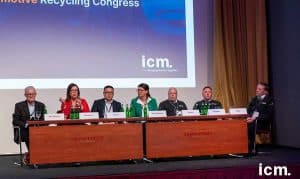
The final session on material circularity brought the discussion back to strategic feedstocks. Ahmad Ghahreman of Cyclic Materials warned that rare earth magnets are becoming a critical issue as electrification deepens. End-of-life recycling remains around 0.2%, he said, even though rare earths are central to electric motors and other key technologies. In comparison, more than 90% of global processing is concentrated in China.
Anaïs Terbeche of Saint-Gobain Sekurit then made the case for automotive glass, describing it as a large but underused material stream. Glass can, in principle, be recycled indefinitely, she said, but only if it is captured and separated properly at the first step. Richard Janssen of TNO closed the conference by applying the same logic to fibre-reinforced thermoplastics, arguing that viable circular supply chains can be built, but only in stages and through collaboration among manufacturers, recyclers and material specialists.


Across Hamburg, the strongest impression was not of a sector waiting for a single breakthrough technology. The technology, speakers repeatedly suggested, is advancing. The harder task is aligning regulation, economics, collection systems, digital traceability and industrial capability quickly enough to support it. At IARC’s 25th anniversary congress, that challenge came into focus in unusually direct terms. The industry may now know more clearly where it needs to go. The real question is whether it can work together fast enough to get there.

The next IARC will be held again in Hamburg from 10 to 12 March 2027.
Source: Auto Recycling World | April 7, 2026

About Us
ICM AG is the international leader in circular economy congress organisation, specialising in vehicle, electronics and battery recycling as well as e-mobility
Find us
ICM AG headquarter: Schwaderhof 7, 5708 Birrwil, Switzerland
ICM Shanghai office: Room A301, Building 3, 526 3rd East Fute Road, Pudong, Shanghai 200131, China
上海市浦东新区富特东三路526号 3号楼A301室 邮编 200131
Contact
info@icm.ch
International number: +41 62 785 10 00
Chinese number 中文号码: +86 21 2076 5627
WeChat 微信: +86 182 176 28910