ICM: Please explain your background and current role at BMW.
Franz Geyer: I currently serve as Head of Technology and Strategy, with more than twenty years of experience at the BMW Group. Throughout my career, I have held a variety of roles across engineering, technology development, and strategic planning. Since 2009, my focus has mainly been on battery technology, helping to drive the BMW Group’s expertise across the entire battery value chain, from technology development and industrialisation to sustainability and circular economy initiatives.
Witnessing the rapid transformation of battery technology over the past fifteen years has been both professionally rewarding and strategically important for the future of sustainable mobility.
ICM: Please tell us more about the Cell Recycling Competence Centre and why it is important to the Group.
Franz Geyer: The Cell Recycling Competence Centre (CRCC) is an important part of BMW Group’s holistic approach to sustainable mobility and circularity. Recycling has long been embedded in our product development philosophy, and this commitment applies to every stage of the battery lifecycle.
At the CRCC, located close to our battery development and pilot production activities, we are advancing direct recycling technologies that enable valuable raw materials from battery cells and production scrap to be recovered and returned directly into the battery value chain. This approach reduces the need for energy-intensive processing steps while helping to preserve valuable resources.
The CRCC is also a key building block in establishing a circular battery ecosystem in Europe. By keeping critical materials in the loop and developing local recycling expertise, we can strengthen sustainability, resilience, and long-term competitiveness.
ICM: How do you see this part of BMW’s activity evolving over the few years?
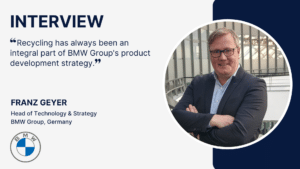
Franz Geyer: Recycling has always been an integral part of BMW Group’s product development strategy, and its importance will continue to grow as electrification accelerates.
For batteries in particular, recycling is becoming a key enabler for a truly circular value chain. As battery volumes increase, the recovery and reuse of valuable materials will play an increasingly important role in reducing resource dependency, improving sustainability, and supporting a resilient European battery ecosystem.
We are confident that advances in recycling technologies, combined with strong collaboration across industry and policy stakeholders, will further improve the efficiency and economic viability of battery recycling in the years ahead.
ICM: What are the key conditions required for a successful future for battery recycling in Europe?
Franz Geyer: Battery recycling will be a cornerstone of a sustainable and competitive battery ecosystem in Europe. To unlock its full potential, several conditions are essential.
First, the industry needs stable and supportive regulatory frameworks that encourage investment, innovation, and industrial scale-up. Second, significant long-term investment from both private and public stakeholders will be required to develop the necessary infrastructure and technologies.
Europe already has strong industrial capabilities and innovative companies in this field. These strengths should be nurtured and supported to ensure that critical know-how, technologies, and value creation remain within Europe.
Ultimately, success will depend on close collaboration between industry, policymakers, researchers, and investors. Together, we can build a competitive, resilient, and circular battery value chain for the future.
About Us
ICM AG is the international leader in circular economy congress organisation, specialising in vehicle, electronics and battery recycling as well as e-mobility
Find us
ICM AG headquarter: Schwaderhof 7, 5708 Birrwil, Switzerland
ICM Shanghai office: Room A301, Building 3, 526 3rd East Fute Road, Pudong, Shanghai 200131, China
上海市浦东新区富特东三路526号 3号楼A301室 邮编 200131
Contact
info@icm.ch
International number: +41 62 785 10 00
Chinese number 中文号码: +86 21 2076 5627
WeChat 微信: +86 182 176 28910