ICM: Please give us a brief overview of Omdia’s activities in the electronics sector and your role.
Ben Caddy: Omdia is a leading tech analyst firm with coverage across the tech landscape that includes IT channel ecosystems, cloud and data center, telecoms and consumer devices, to name a few areas. Our role as analysts is to stay close to the ground and help our clients navigate the opportunities and challenges across the tech sector by providing them with research, advisory and market intelligence that ultimately drives them to make the right investments and strategic decisions.
I come from the IT channel part of Omdia, previously known as Canalys, and my role is to help tech companies, whether they’re IT resellers, distributors or vendors — integrate sustainability into how they approach the market. One of my core research focuses since starting this role over 4 years ago has been the circular economy, which is a huge area of interest and opportunity for the IT channel. In my day job, I help companies in this vast IT ecosystem understand where the opportunities lie in circular IT, how they need to approach and frame this, and critically, who they may need to partner with.
ICM: What are the key challenges you have identified for creating circularity in the electronics market?
Ben Caddy: The fundamental one that holds us all back is that we’re often fighting against a tech business model where success is only defined by new hardware sales, not the depth of service provided or the customers’ ability to use technology in a way that works best for them. There’s an uphill battle for channel partners to be recognized for the work they’re advancing in terms of circular solutions for customers, because they are still often pressured to focus on new sales and not refurbished tech, or even solutions that extend lifecycles. The good news is that the current market conditions are forcing a bit of a rethink, even if it’s slower than it should be.
Another one that is often neglected is that it’s not just about durable, repairable and modular hardware designs, but it’s also about OS support. A lot of viable technology is still prematurely retired when a vendor decides to end the OS support, which worsens the e-waste crisis.
The final point I’d make is that there’s not yet enough harmony in terms of how we define a refurbished product, or indeed a ‘more sustainable’ product. Terms like pre-owned, refurbished, remanufactured, etc. are often used in a confusing and inconsistent way, and there’s still a lack of standardization on hardware grading too. But there are really promising signs that these situations are going to improve in the next few years.
ICM: What conditions are necessary in order to address them?
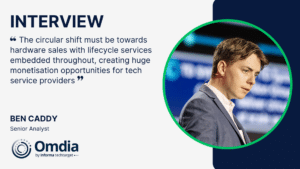
Ben Caddy: The macro conditions need to be just right for the industry to move forward on circularity and while we have seen some positive movements as a result of the sustainability movement, the real momentum is going to come from the harsh reality of resource scarcity and what that means for pricing. The AI data center buildout has inadvertently created some great market conditions to build circularity at scale, but to capture this fully, the manufacturers driving the industry need to become more comfortable with customers’ increasing openness to refurbished tech. That means shifting away from transactional hardware sales every few years and towards hardware sales with lifecycle services embedded throughout a longer lifespan and this is where the monetization opportunity comes in.
ICM: How confident are you that circularity can be achieved and in what timeframe?
Ben Caddy: When you work in sustainability, you need to maintain some cautious optimism. The general direction of travel on the climate crisis is especially alarming today, but in contrast, I believe circularity has never been in such a strong position as it is today. The UN’s E-Waste Monitor reports highlight the sheer scale of the challenge, but by 2040, I am sure the tech industry will have made very significant progress in circularity because of the economic logic behind it and critical metal scarcity is already forcing better circularity rates. The real challenge is how we, as an industry, integrate the business and the consumer pieces here to maximize hardware reuse at a global scale, especially in developing markets.
Source: ICM | November 2026

About Us
ICM AG is the international leader in circular economy congress organisation, specialising in vehicle, electronics and battery recycling as well as e-mobility
Find us
ICM AG headquarter: Schwaderhof 7, 5708 Birrwil, Switzerland
ICM Shanghai office: Room A301, Building 3, 526 3rd East Fute Road, Pudong, Shanghai 200131, China
上海市浦东新区富特东三路526号 3号楼A301室 邮编 200131
Contact
info@icm.ch
International number: +41 62 785 10 00
Chinese number 中文号码: +86 21 2076 5627
WeChat 微信: +86 182 176 28910