Interview with Pan Wang: CATARC’s Role in China’s Battery Recycling Industry
October 19th, 2026
Back to posts
October 19th, 2026
Back to posts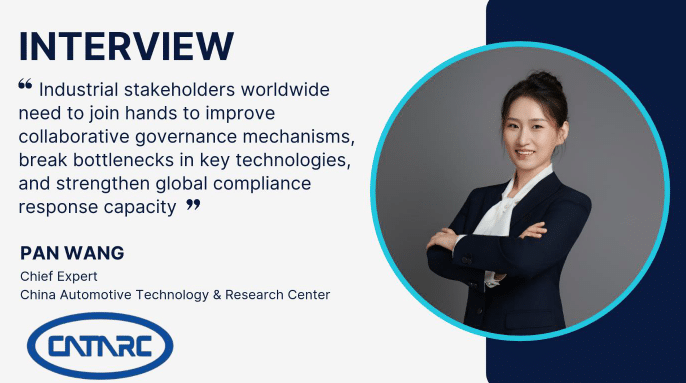
ICM: Please tell us what Catarc’s role is in battery recycling in China and also your role.
Pan Wang: As a technical support institution for the automotive industry, China Automotive Technology & Research Center (CATARC) stays true to its original aspiration of advancing scientific and technological progress in China’s automotive industry. CATARC is committed to providing intellectual support to competent government authorities and delivering comprehensive, high quality technical services for the automotive industry.
In the field of waste traction battery recycling and utilization for new energy vehicles in China, CATARC provides in depth support for competent government authorities in conducting research on policies and regulations, building a full life cycle traceability management system for traction batteries, carrying out special industrial investigations, and other tasks, and takes an active part in developing the national standard system.
On the other hand, drawing on years of accumulated industrial research expertise and grounded in industry practices, CATARC offers professional consulting services for upstream and downstream stakeholders across China’s industrial chain, including industry trend analysis, technical route demonstration, project compliance assessment and development strategic planning, to foster a sound industrial ecosystem.
Pan Wang: As a Chief Expert of CATARC, I have long been engaged in automotive circular economy, traction battery recycling and utilization, and Extended Producer Responsibility (EPR). I have presided over multiple national and provincial research projects in China as well as international cooperation projects under the Global Environment Facility (GEF) and led the formulation of more than ten management specifications for traction battery recycling and utilization systems.
This year, our team supported the release of China’s first ministerial regulation governing traction battery recycling and utilization, namely the Interim Measures for the Administration of Recycling and Comprehensive Utilization of Waste Traction Batteries from New Energy Vehicles, contributing China’s practical experience to global governance of traction battery circularity.
I also look forward to leveraging ICM 2026 to engage in dialogue and mutual learning with experts and scholars worldwide and jointly explore development pathways and collaborative governance solutions for the global industry.
ICM: What are Catarc’s priorities for the next few years in the battery recycling sector?
Pan Wang: CATARC will continue to deepen its work in traction battery recycling and comprehensive utilization. It will prioritize improving China’s regulatory system for traction battery recycling and utilization and fully support research for industry related legislation. Special management research will be carried out focusing on key links across the whole chain of production, recycling and comprehensive utilization.
For important topics including traction battery traceability management, administrative licensing for comprehensive utilization, and industrial incentive measures, CATARC will scientifically put forward management solutions tailored to industrial development.
ICM: How do you support the automotive and battery recycling industries?
Pan Wang: We provide specialized support for the industry across three dimensions: policy compliance consulting, industrial development and data services, as well as talent and skill training. Drawing on our accumulated research on laws and regulations governing traction battery recycling and utilization for new energy vehicles, we help enterprises clarify compliance boundaries, establish and optimize their internal compliance management systems, and improve compliance capacity at both enterprise and industry wide levels.
We keep track of industrial performance on an ongoing basis, deliver industrial research reports and customized project consulting solutions, and offer multi-dimensional industrial data support. Meanwhile, to meet the industry’s demand for interdisciplinary professionals, we build an industry talent collaborative development system.
We deliver talent development services for practitioners along the industrial chain integrating skill training, job competency certification and international exchange and cooperation, to empower high quality development of the automotive and traction battery recycling industries.
ICM: You are a keynote speaker of the World Recycling Forum taking place in Shanghai in November this year, what challenges and opportunities do you see for the future of these businesses?
Pan Wang: It is my great honor to be invited as a keynote speaker at this forum to share my observations and reflections on the global traction battery circular industry.
In terms of opportunities: First, the global stock of new energy vehicles keeps rising rapidly. Waste traction batteries, represented by those from China, have entered a large-scale decommissioning phase, and other major markets across the world will successively reach their peak decommissioning periods. The global recycling market continues to expand, while cross border resource flows are accelerating. Second, against the global carbon neutrality backdrop, recycled metals such as lithium, cobalt and nickel demonstrate increasingly prominent low carbon advantages, and the supply chain value of recycled materials keeps emerging.
As for challenges: First, business models for comprehensive utilization remain immature. Quotation prices for waste traction batteries are highly vulnerable to fluctuations in commodity prices. Second, fast evolving global green regulations and growing cross border green trade constraints will drive up compliance costs for global cross border industrial chains and trade.Overall, the global traction battery recycling industry faces both opportunities and challenges. Industrial stakeholders worldwide need to join hands to improve collaborative governance mechanisms, break bottlenecks in key technologies, and strengthen global compliance response capacity, to jointly foster steady and sound development of the traction battery circular industry.

About Us
ICM AG is the international leader in circular economy congress organisation, specialising in vehicle, electronics and battery recycling as well as e-mobility
Find us
ICM AG headquarter: Schwaderhof 7, 5708 Birrwil, Switzerland
ICM Shanghai office: Room A301, Building 3, 526 3rd East Fute Road, Pudong, Shanghai 200131, China
上海市浦东新区富特东三路526号 3号楼A301室 邮编 200131
Contact
info@icm.ch
International number: +41 62 785 10 00
Chinese number 中文号码: +86 21 2076 5627
WeChat 微信: +86 182 176 28910