ICM: Please give us a brief overview of the recycling activities of Aurubis.
Inge Hofkens: Recycling is at the core of Aurubis – it’s an important part of our DNA. We process a very broad spectrum of materials, from copper scrap and industrial residues to complex electronic scrap and precious metal bearing feed. We combine the advantages of processing primary and secondary raw materials, which go hand in hand for us – because we need both to meet the growing demand for copper and other metals. Up to 50% of our copper output in 2030 are planned to come from recycling, complemented by the recovery of nickel, tin, gold, silver, selenium, and PGMs. There are multiple secondary smelters in our international network: Our site Lünen, Germany, is among Europe’s largest multimetal recycling centers. The site brings deep expertise in processing complex recycling streams, combining advanced sampling, smelting, and hydrometallurgical refining to achieve excellent recovery rates across multiple metals. Our Belgian sites in Olen and Beerse further strengthen the smelter network – Olen with strong refinery and precious metal expertise, Beerse with advanced processing of complex intermediates. They are extended by our Berango site in Spain. With Aurubis Richmond, we have recently added the first of its kind multimetal recycling smelter in the U.S., that expands our global footprint.
ICM: What does “closing the loop” mean for Aurubis?
Inge Hofkens: Closing the loop means turning complex recycling materials into high quality metals that go straight back into new products – reliably and at industrial scale. Across the Group, we operate more than 1 million tons of recycling capacity and maintain over 150 longterm closing the loop partnerships with customers from electronics, automotive, and other industries. These partnerships secure material streams while offering customers transparency and security of supply. Projects like Complex Recycling Hamburg – an innovative facility that gives the capacity to process around 30,000 additional tons of recycling material and further complex smelter intermediary products – and the ramp up of Aurubis Richmond further strengthen our ability to treat increasingly complex materials. Closing the loop for us is not a slogan, it is a measurable contribution to resilient, circular metal supply chains in Europe and Northern America.
ICM: How important is this activity for the group overall and how do you see it evolving in the next few years?
Inge Hofkens: Recycling is strategically and economically essential for Aurubis. Demand for copper, nickel, tin, and precious metals is rising sharply, driven by electrification, renewable energy, and digital infrastructure – and recycling is key to meeting this demand sustainably. A major milestone is Aurubis Richmond, our state-of-the-art secondary smelter for complex recycling materials in the United States, giving us a clear first mover advantage in a fast-growing market. Once fully ramped up, Richmond will be able to process up to 180,000 tons of complex recycling materials per year. Together with our European expansion projects, this will significantly increase the share of recycled raw materials in our metal output. Recycling will remain one of the strongest growth drivers for the Group.
ICM: What are Aurubis’ ambitions in this sector?
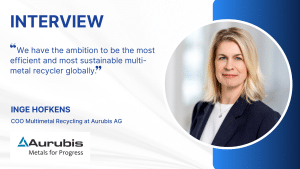
Inge Hofkens: We have the ambition to be the most efficient and most sustainable multimetal recycler globally – and we can already demonstrate what that means in practice. Today, Aurubis recovers a broad range of strategic metals, including copper, nickel, tin, and precious metals, at very high yields. Our ambition is to continuously expand our ability to treat increasingly complex recycling materials, such as electronic scrap and industrial residues, which many others cannot process at scale. In Europe, we are strengthening our leadership through targeted investments in Europe, while Aurubis Richmond positions us strongly in North America. We are investing in innovation, digitalization, and decarbonization to improve recovery rates, energy efficiency, and environmental performance at the same time. And by building long-term partnerships with the electronics, automotive, and battery industries, we enable true closed loop solutions that combine supply security, sustainability, and economic value.
ICM: What are the main challenges you face in order to continue to develop and grow this activity?
Inge Hofkens: Our aim is to secure a strong, sustainable supply of strategic metals for European and American industry – and recycling is absolutely central to that. In order to achieve this, we are facing several challenges. First, collection and design are key: higher collection rates and product designs that are better suited for recycling are essential to unlock the full potential of circular metals and ensure that valuable materials are not lost at the very beginning of the value chain. Second, it is crucial to ensure that recycling materials remain in Europe – as today, large volumes of recycling materials are still exported. Third, we need a more aligned approach across member states, with harmonized rules and enforcement, to avoid fragmentation and competitive distortions within Europe. Fourth, from a material and operational perspective, recycling streams are becoming increasingly complex, with a growing share of organic components, which significantly raises technological requirements. At the same time, we are transforming our production by consistently reducing CO₂ emissions – while ensuring that sustainability and economic viability go hand in hand. As an energy-intensive but highly energy-efficient industry, we also depend on reliable access to energy at competitive prices in Germany and Europe to avoid structural disadvantages compared with global competitors. Thanks to our outstanding technologies and deep metallurgical expertise, we are able to meet these challenges and turn them into scalable, industrial solutions.
ICM: How confident are you in the future of this industry and why do clients choose you?
Inge Hofkens: Very confident – metals are essential for the energy transition, digital infrastructure, modern mobility, and national security. Demand for many strategic metals will continue to rise, and recycling is the most sustainable and resilient way to meet that demand. Customers choose Aurubis because of our high recovery rates, our ability to process complex materials, and our strong environmental performance. This is also reflected in our Life Cycle Assessment results: Aurubis copper has a CO₂ footprint that is less than 60% of the global industry average, a clear advantage for our customers. At Aurubis, we summarize our wide-ranging activities in the area of sustainability under our customer promise Tomorrow Metals. With Aurubis Richmond, we also offer regional recycling capacity in North America, strengthening supply security. Reliability, innovation, and responsibility are why customers trust Aurubis as a long-term partner.
ICM: Delegates at the IARC 2026 will visit your plant near Hamburg – what will they see?
Inge Hofkens: Delegates will visit the central hub of Aurubis’ integrated smelter network. While Hamburg is not a site specialized exclusively in recycling, it plays a crucial role in processing and refining both primary concentrates and a significant share of metals originating from recycling materials across our network. At the Hamburg plant, concentrates, recycling materials and recycling derived intermediates from other sites of the Aurubis smelter network are further processed into high quality copper cathodes and precious metals – in addition to further strategically important metals such as tin, zinc, and lead. The site brings together primary metallurgy, advanced refining, precious metal processing, and highly sophisticated sampling and analytical systems, ensuring transparency, efficiency, and consistently high metal yields. Investments such as Complex Recycling Hamburg enhance Hamburg’s ability to treat complex intermediates and recycling related material streams within Europe. Beyond metallurgy, Hamburg also demonstrates how industrial production and decarbonization go hand in hand – for example through the largescale supply of industrial heat to the city. Overall, delegates will experience how Hamburg connects primary production and recycling into a resilient, integrated supply of strategic metals. The location shows that modern multi-metal production can also function close to urban areas – since 2000, we have invested almost €500 million in environmental protection.
We look forward to showcasing efficient and sustainable multi-metal production at Aurubis Hamburg – a unique downtown smelter located just 4 km away from Hamburg City Hall.
About Us
ICM AG is the international leader in circular economy congress organization, specialising in vehicle, electronics and battery recycling as well as e-mobility
Find us
ICM AG headquarter: Schwaderhof 7, 5708 Birrwil, Switzerland
ICM Shanghai office: Room A301, Building 3, 526 3rd East Fute Road, Pudong, Shanghai 200131, China
上海市浦东新区富特东三路526号 3号楼A301室 邮编 200131
Contact
info@icm.ch
International number: +41 62 785 10 00
Chinese number 中文号码: +86 21 2076 5627
WeChat 微信: +86 182 176 28910